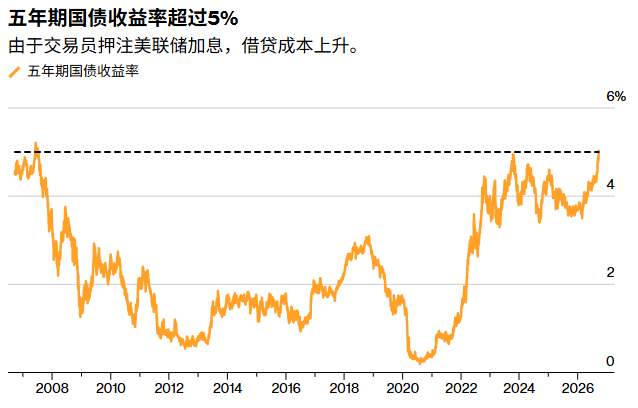
On Monday, the U.S. 10-year Treasury yield surpassed 5% for the first time since 2023, driven by mounting inflation concerns clashing with rising government and corporate borrowing demand.
As a benchmark for U.S. mortgage rates and global bond yields, the rate surged nearly 5 basis points to 5.01%, before easing as buyers stepped back. In early Asian trading on Tuesday, it held steady around 4.98%.
“Five percent is clearly a key psychological threshold for investors—some may have already planned to buy at this level,” said Molly Brooks, U.S. interest rate strategist at TD Securities.
Rising oil prices stoked inflation worries ahead of this week’s Federal Reserve decision, initially pushing bond prices higher. The last time the 10-year yield breached the 5% mark was in October 2023, and that rise lasted only one day.
The increase in the U.S. 10-year Treasury yield could slow economic growth and weigh on overvalued equities. This has prompted Treasury Secretary Scott Bessent to intensify bond buybacks, urging Japan to reduce its debt issuance and consider cutting long-term debt supply. Bessent has consistently emphasized long-term borrowing costs as a key measure of government performance.
With less than two months until the U.S. midterm elections, the 10-year Treasury yield is now about one percentage point higher than it was before the outbreak of war in Iran.
However, this sell-off also reflects deeper structural factors driving up long-term yields across major developed markets. The gauge of global government borrowing costs has climbed to its highest level since 2007. As fiscal deficits widen and governments and corporations issue massive amounts of debt to fund artificial intelligence infrastructure, investors are demanding higher returns on long-term debt holdings.
“For now, continued rate declines appear to be the path of least resistance, supported by many underlying factors,” said Zack Griffith, head of investment-grade and macro strategy at research firm CreditSights. He noted that the 10-year Treasury yield could rise to around 5.5%.
Since 2007, the U.S. Treasury market has ballooned from approximately $4.5 trillion to about $32 trillion, causing federal debt to exceed 100% of GDP. In August, Fitch Ratings warned that as debt levels continue to climb, the United States is “extremely vulnerable to future economic shocks.”